
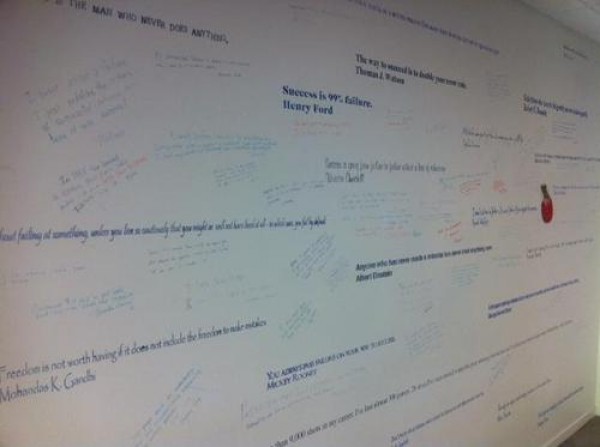

A few weeks ago, I wrote about avoiding social media failures. I briefly mentioned our company’s “Failure Wall” and was surprised by the number of comments and questions I received about it. What’s the purpose? How does it work? And what other kinds of things do you do in that crazy office of yours?
The failure wall was part of our efforts to create a company culture where employees can take risks without fear of reprisal. As NPR’s Here and Now reported earlier this year, we started by collecting inspirational quotes about failure. Among my favorites:
“Success is going from failure to failure without loss of enthusiasm.”
– Winston Churchill
“I have not failed, I’ve just found ten thousand ways that won’t work.”
– Thomas Edison
“Mistakes are part of the dues one pays for a full life.”
– Sophia Loren
One random Thursday night, I returned to our corporate headquarters afterhours with a bottle of wine and a box of acrylic paints. My assistant and I used stencils to paint about three dozen such quotes onto a large white wall in our break room. As first time stencilers, this project itself seemed destined to end up a byline on the (slightly gloppy) failure wall until we gratefully accepted some much-needed painting assistance from my wife.
After we finished painting around 1:00AM, we fastened a dozen Sharpies to the wall alongside these simple instructions: (1) describe a time when you failed, (2) state what you learned, and (3) sign your name. To set the tone, I listed three of my own most memorable (and humbling) failures.
In the beginning, the wall was met with surprise, curiosity and a bit of trepidation. We didn’t ask anyone to contribute and we didn’t tell people why it was there, but the wall quickly filled up. Some of the entries are life lessons: “After 7 years of practicing, I quit playing violin in high school to fit in. Lesson learned — who cares what other people think.” Some are financial mishaps: “I thought buying Yahoo at $485 a share was a good idea.” Many are self-deprecating: “My successful failure is working in online marketing when I came to LA to work in showbiz.” Some are more than a little amusing: “I thought it was spelled ‘fale.'”
I’ve said this before but it bears repeating: success by failure is not an oxymoron. When you make a mistake, you’re forced to look back and find out exactly where you went wrong, and formulate a new plan for your next attempt. By contrast, when you succeed, you don’t always know exactly what you did right that made you successful (often, it’s luck).
We don’t just encourage risk taking at our offices: we demand failure. If you’re not failing every now and then, you’re probably not advancing. Mistakes are the predecessors to both innovation and success, so it is important to celebrate mistakes as a central component of any culture. This kind of culture can only be created by example – it won’t work if it’s forced or contrived. A lively culture is nebulous, indefinable, ever-changing. Try to package it in a formal mission statement and you just may suffocate it.
The best way to shape culture is of course to focus on hiring the people who will ultimately make up that culture. Yet this is often overlooked, replaced with corporate values, slogans, and mission statements. It took billions of years to create and define all of the world’s great cultures – through failure after failure – so it is with arrogance alone that we executives think we can create and define one for our company. To be blunt, cultures are not created or defined by executives; they evolve around the people who make up a company.
I personally interview every candidate at our corporate headquarters. By the time a prospective employee’s resume reaches my desk, the department heads are convinced that the candidate can do the job. But for each person we end up hiring, I still end up interviewing countless other highly qualified candidates who were vying for the job. I’m mainly looking for cultural fit, and there is no more important job for a CEO.
If we hadn’t hired people who cherish failures, my entries on the failure wall would be very lonely. Often when interviewing, I poke around and see if I can get the candidate to acknowledge a failure. It’s a red flag to me if a candidate can’t admit a mistake with a bit of self-deprecating humor. The tendency to dodge direct questions with a Miss America-style answer may indeed be a great asset to someone else’s company, but it’s not a great fit for success at mine.