

Design Engine Publication
A Resource for Design and Engineers to Good Design


Ideas, Thoughts, & Perspectives

March 21st, 2011

Ultraviolet LED + GFP Bacteria Project

More articles by »
Written by: alexsimes
Tags: , , , , , ,
Alex Simes BFA Project

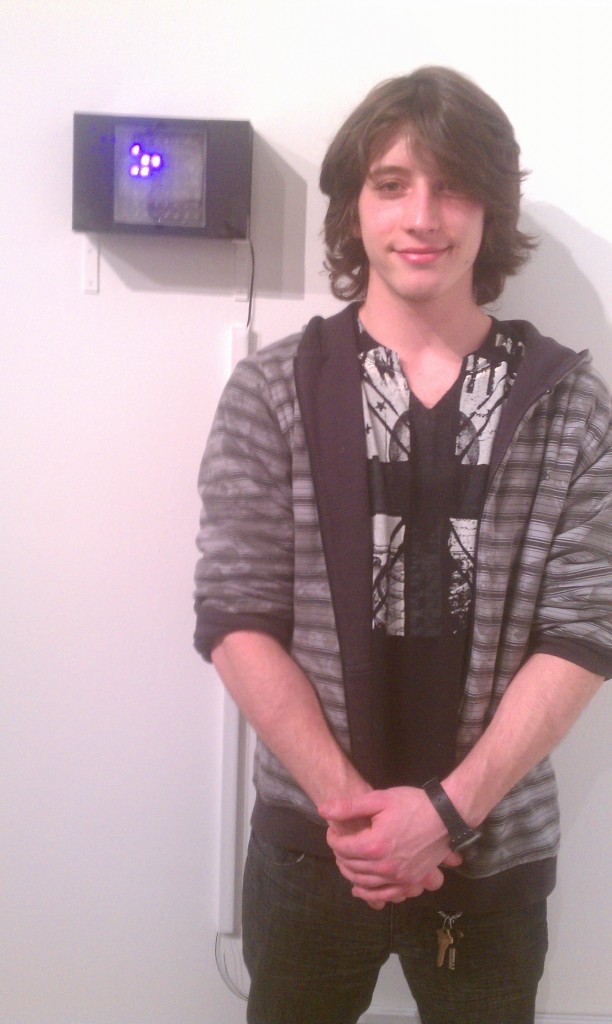
The senior BFA show at The School of The Art Institute of Chicago opened last Friday and is currently showing. For the show I presented a project I had made in the Bio Art class last semester. The piece was an Ultraviolet LED grid programmed to display Conway’s Game of Life. In addition GFP bacteria (bacteria that glow green under UV light) were placed in a custom Petri dish on top of the UV LED grid. The intended goal was for the bacteria to function as pixels displaying the programmed game.

Conway’s Game of Life is a zero-player game that takes place on a square grid of arbitrary size (size being the width or height in units as opposed to a physical measurement). There are different ways to begin the game but the approach I took was randomly turning every LED on or off whenever the game reset. In the game each LED that is on represents a “live” cell and every LED that is off represents a “dead” cell. Because the LEDs are arranged on a square grid each has 8 neighbors (top, right, bottom, left, diagonals). The rules of the game are:

  • If a living cell has 2 or 3 neighbors it remains on (alive).
  • If it has less than 2 neighbors it dies of “under population” and if it has more than 3 it dies of “overpopulation” and turns off.
  • A dead cell can come back to life if it has exactly 3 living neighbors.

All of these rules are run on the board for every LED in the grid at the same time once a second. If everything dies or a pattern continues for a minute then the game resets. An example of Conway’s Game of Life running can be found here.

Conway’s Game of Life is an idealized model (called a cellular automaton) that tries to represent single celled organisms interacting with one another. Placing the bacteria on top of the game then functions as real single celled organisms projecting idealized single celled organism interactions.

Article Written by: Alex Simes


About the Author

alexsimes
Programmer, web designer, and gymnastics coach


Design Engine Industrial Design Training Pro Engineer


Saab_01

Saab 1937-2012, Continuation or End of an Icon?

One of the most notable absences from this year’s auto show was that of the iconic Swedish name, Saab, which was typically much anticipated and always looked upon to deliver prime examples of design and engineering excell...
by designengine
0


Scott_Robertson_06

Drawthrough: The Personal and Professional Work of Scott Robertson

Here are some selections from Scott Roberston’s blog, Drawthrough JR. Head on over to follow work-in-progress updates on his future books and other creative experiments. You can the full size images HERE. Click To View Im...
by designengine
1


brainstorming-design-engine

The Brainstorming Process Is B.S. But Can We Rework It?

Two recent articles argue that brainstorming doesn’t make people more creative, so how might we remake the brainstorming process given what science tells us? The business practice of brainstorming has been around with us ...
by designengine
0


tip-designers-company-culture

3 Tips For Designers: Making People Love to Work with You

To be a great designer, you don’t only have to walk the walk, you also need to talk the talk. I’m a product development project manager with a small New York start-up in China and I love to work with creatives from around t...
by designengine
0


is-it-creativity-or-is-it-jargon

Is it Creativity or is it Jargon?

Business leaders lean on terminology like “design thinking” to define and quantify the process for innovation. It doesn’t matter what you call the process, what we all desire is more creativity in the process. Cre...
by designengine
0


0 Comments


Be the first to comment!


Leave a Reply

Your email address will not be published. Required fields are marked *

*

You may use these HTML tags and attributes: <a href="" title=""> <abbr title=""> <acronym title=""> <b> <blockquote cite=""> <cite> <code> <del datetime=""> <em> <i> <q cite=""> <strike> <strong>