
FEA Training Courses (Finite Element Analysis)
Every prototype you don’t build is money saved. Every failure you catch before tooling is a schedule you keep. Design Engine’s three-day and week-long FEA courses teach engineers to apply realistic loads, evaluate stresses, and validate product performance with confidence so simulation becomes a practical engineering tool, not a box to check.
Stress analysis is a critical skill for all engineers looking to expand their technical expertise and increase value to their team.
Who is this FEA training for?
- You’re a mechanical engineer or product designer already working in Creo or SOLIDWORKS
- Your team validates designs with physical testing today and needs to catch problems earlier
- You inherit simulation results from an analyst and want to run and trust your own
Intro to Creo Simulate
Intro to SolidWorks Simulate
Advanced Creo Simulate
Advanced SolidWorks Simulate
Interested in FEA training?
Finite Element Analysis (FEA) training equips Mechanical Engineers and Product Designers with the skills needed to validate designs before they reach production. While proficiency in CAD tools such as Creo and SOLIDWORKS is essential, engineers must also understand how products perform under stress and various conditions. Design Engine’s FEA training provides the ability to evaluate stresses, deflections, fatigue, and structural integrity, giving teams greater confidence in various design decisions.
FEA training is a critical step in the product development process. CAD software allows engineers to create detailed geometry and assemblies, but FEA enables them to predict how those designs will behave when subjected to loads, heat, vibration, and other operating conditions. Learning FEA requires a different way of thinking, one that combines engineering fundamentals, simulation techniques, and problem-solving creativity.
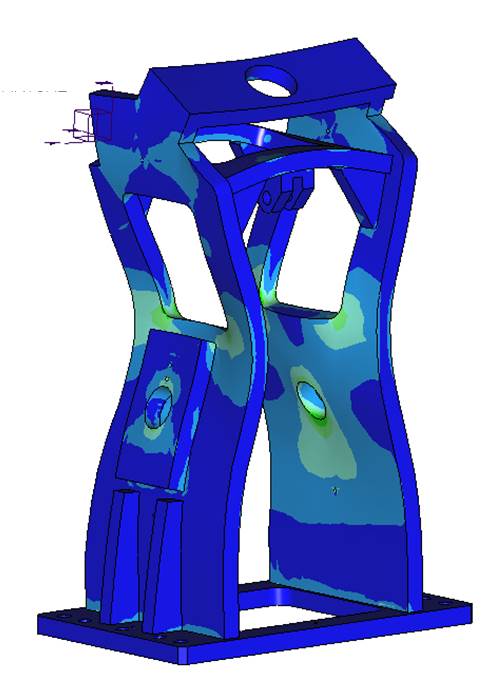
Our FEA courses teach participants how to set up accurate simulations, interpret results, identify potential failures, and make informed design improvements. The goal or our Simulation training is not simply to generate colorful stress plots, but to develop the judgment and confidence needed to use simulation as a practical engineering tool.
Why use FEA withing your design process
Great products aren’t built by trial and error; they’re engineered with confidence. And it’s far cheaper to get the design right up front than to change it after tooling.
FEA lets you predict how a product performs before it’s manufactured. Instead of relying on costly prototypes and repeated testing, you simulate real-world loading, find weak points, and optimize the design early while changes are still cheap. For many teams, multiple physical prototypes simply aren’t an option: tight schedules, demanding customers, and expensive tooling mean the product has to work the first time.
The payoff: fewer prototypes, fewer design iterations, lower development cost, and confidence before the first part is cut.
What you will actually learn?
Design Engine’s FEA training goes beyond software commands. You’ll learn to:
- Define realistic boundary conditions and load cases
- Understand solver assumptions — and when results should and shouldn’t be trusted
- Choose between linear and nonlinear analysis (metals in their elastic range vs. plastics, elastomers, large deformations, and contact)
- Interpret stress, displacement, and factor-of-safety results
- Turn simulation output into informed design decisions
Whether you’re validating machined components, plastic parts, weldments, sheet metal, or complex mechanisms, you’ll leave with skills you can apply to your own products immediately.